Easter Sunday: A Normal Day at Stoneywish

 Public Holidays are working days for us. Nevertheless I try not to let such times slip by without a sense of celebration. So for Easter I plan a breakfast of fresh-laid chuckie-eggs and homemade brioche, courtesy of the new bread-maker. Michael sets off for work just after six a.m. with instructions not to stay out cutting stinging nettles after he has fed the animals. Breakfast will be at 8 sharp. At seven he returns, but my hopes of a restful start to the day are short-lived. One of our sheep - last year's bottle-lamb, Spotty, to be precise - has managed to wedge her head through the bars of a metal gate and, due to her horns, cannot be extricated. Do I have a hack-saw? No, I do not. And as she cannot be left in such a parlous state, I call the Fire Brigade and we both set off to the Car Park to await the arrival of professional help. The fireman show great gentleness and understanding, for their Easter breakfast has probably also gone by the board, and manage to cut Spotty free without any trauma, After staggering about a bit, she heads off for a rest in the shade before resuming her grazing. I would like to think she has learnt something about the value of seeking greener grass on the other side, but I suspect she has not!
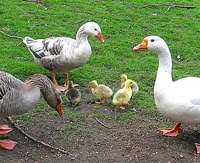 Within an hour I am rounding up a dog which has strayed from one of our neighbour's houses and is running amongst the geese and their newly hatched goslings. These six babies, now gawky on long legs, were, at Easter, still helpless balls of fluff, zealously guarded by their parents and a gaggle of aunties and uncles who were bold enough to fly at the sheep if they came too close. But even a bold goose is no match for a dog. By the time I have chased him home and returned to the house, it is getting on for midday.
 No matter, the weather is warm and sunny and the apple blossom hums with bees in the orchard. Perhaps an Easter lunch outside will make up for breakfast? We pile bread and salad onto plates and just as we head out of the kitchen the telephone rings: Is Michael there? There is water pouring through the ceiling of the Visitor Centre kitchen. It looks as if the tank has burst again...
Two emergency plumbing trips later, pigs fed, chickens shut away, and visitors and staff departed after the excitement of the Easter Bunny Hunt, we anticipate a quiet evening. But perhaps it would be better to make no further plans! Fate has such an arsenal of practical jokes to play on the unwary. Half way through dinner someone calls to say that a fox has carried off one of the goslings and the thought haunts me late into the night.
 Next morning however, I find all in the top field still alive and well. In addition the noisy Canadas have hatched three young of their own on the Black Swan Pond. I count six ducklings, darting about, hunting flies on the water surface and also spot four moorhen chicks, hidden under the overhanging foliage that obscures their nest. The cuckoo has been calling for a week now.
 This surge of life brings its triumphs and tragedies. With the warm weather, two sheep, though treated already, succumb to fly-strike and Michael and his grandson, Mike, have the unenviable task of dealing with the flesh-eating maggots which have burrowed into their wool. And the heron returns to the Black Swan Pond and perches at the top of the weeping willow, waiting to swoop on my unsuspecting nursery.
 Two weeks on, I have four duckling survivors, but only one moorhen, lovingly tended, as only baby moorhens can be. The Canadas have taken their family to the safety of the Big Pond where they were welcomed by a raucous flotilla of geese. Meanwhile, despite their water drying up alarmingly fast, the top flock have continued to protect their goslings and their unflagging vigilance makes a very moving sight.
 And already it is May. Today's news becomes out of date even as I write it. Elder bushes flower where the apple and rowan bloomed before. Great drifts of red campion and blue alkanet lie between the trees along the Big Pond edge, the best I have ever seen and May blossom foams in the hedgerows. You would not guess that we have been without rain for five weeks or more. Shaun McCullagh came at Easter and did a new bird count for us, recording whitethroat and lesser whitethroat, blackcap and reed warbler this time, in addition to our usual residents. And Michael has met a baby fallow deer twice on his rounds in the early morning, which is lovely for the blog and (deer being voracious eaters of roses) rather worrying for the Herb Garden!
We finally got our lazy breakfast on May morning!
 Here are some details about camping at Stoneywish. If you would like to make a reservation, please telephone our ticket office during opening hours (Fri-Mon 10 a.m. - 5 p.m. during school term time and every day 10. a.m. - 5 p.m. during school holidays March to October inclusive). You can also book through www.grasshoppers-uk.com
 Facilities

 That country saying about not casting clouts in May has certainly proved wise advice this year. (Gardeners and farmers know that frosts here, even in the south, can catch early strawberries, so I reject the recent reading of 'May' as whitethorn blossom. No one would
 The last few weeks have seen a mass fledging of baby birds in the Reserve. The vegetation resounds all day long with their high-pitched 'tseet-tseet-tseet' and we have been lucky enough to see little flocks of blue tits and great tits venturing from tree to tree and still fluttering their wings for gifts of grubs from their parents. The collar doves, which nested above our front door, have successfully reared two young and we have blackbirds and wrens busy guarding nests nearby. The dense tangle of undergrowth here gives them a chance against marauding magpies, though it is not always easy to explain this when Chelsea still sets the model for gardening! A visiting maintenance engineer recently popped his head over the fence and stared in wonder at the long grass and rampant rambler roses:
 "What's this then, 'The Darling Buds of May'?" We took it as a compliment for, honestly, it is such a joy to step out into a Baby Bird Garden, I feel certain we could convert even the diehards of the RHS! Yesterday, on my way to feed the chickens, I heard more high-pitched juvenile voices and spotted 10 or more goldcrests in a pine tree, hopping about like jumping beans and making the same fluttering petitions for food. And other babies abound here too, rabbits and squirrels and fox cubs, harder to see.
  Wild roses and foxgloves are now in bloom in the Reserve; the Apothecary's Roses in the Herb Garden merit a visit for their heavenly scent, and everywhere still looks remarkably lush, despite two months of drought. The Austrian scientist and naturalist Victor Schauberger, claimed that trees could create water, deep underground, through the chemical action of their roots, and considering how much water a single willow transpires in a day, I can think of no other reason for them surviving so well.
  We are so often burdened with a sense of responsibility for maintaining everything in the world, I like the idea of such invisible processes which sustain us without fuss or fee.
 As for the goslings, they are now great lumping adolescents, difficult to distinguish from their parents at a glance, but still rather downy and squeaky on closer inspection. The ducklings too have gained their feathers, just as all the big birds are losing theirs, for the great summer goose moult is now
  Anyone who wants to make their own Warrior's Headdress to wear at the Wild West Fort in the Play Area, should hurry here while stocks last!!

 Suddenly everything is bursting into life. While geese, ducks and moorhens are busy guarding their nests on the Reserve a tide of green is seeping over the hedgerows. Pussy willow is out. The chiffchaffs have arrived from Africa and you can hear their distinctive notes, calling their own names, quite clearly, among the other bird cries. And our family of farm animals is growing too. Two dear ginger-spotty piglets have joined the gang in the Smallholding and another lamb was born last week. On the Black Swan pond, the Canada Geese and the swans have called a truce and have settled down to nest beside one another on the island. While their womenfolk are occupied, the males warily patrol the waters round them, all raucous displays of greeting and warning temporarily halted. In the folk mythology of Finland, Tuonela, the Underworld, is surrounded by waters which are guarded by a lone black swan. Black swans come from Australia so the 'Swan of Tuonela' was a piece of pure imagination on the part of Finland's pre-christian storytellers, but their tale inspired a haunting tone poem by Sibelius, and I cannot help hearing his music in my head as I see our miniature epic unfolding here.
 Carpets of spring flowers are appearing now: primroses, violets, the beautiful oxlips, which have colonised a corner of the woodland coppice,
 and mantles of wild garlic, and bluebells are close behind, while the blackthorn, crab apples and orchard fruit trees are only days away from breaking bud.
 There are plans for some turkeys to join the hens in the orchard. Already the Oxford Sandy and Black piglets have turfed up the grass in their pen and learnt that a snout is a good powerful tool for levering fences up high enough to escape into the world at large. They can run fast too! Michael was called out two days ago to catch them before they set to helping to dig the vegetable beds!
 A week or so back we took delivery of two ponies, which Charlie Camp from Clayton made for us out of his locally grown chestnut wood, and they are now stationed close to the Indian Tepee and newly refurbished Wild West Fort in the Play Area, waiting for child adventurers to scramble on their backs. Charlie makes all manner of beautifully crafted items in wood, from wellie-racks to garden furniture and we are hoping to add his handiwork to the things for sale in our shop.
