The tawny owls have started calling again. I am not sure whether they have a lull in their nocturnal communications, or whether they go off somewhere else in the summer, but for the past two nights they have been very vocal and it is lovely to hear them once more beyond the trees. Under bright stars yesterday, the sense of near and far was accentuated by the silvery chirr of crickets in the garden. This side of the field, summer still. Out there, reminders of an autumn tide that is flooding in on the darkening mornings.
This is what the campers say they love - a chance to hear and notice the quiet things that city life blocks out. Blackberry pickers skirt the hedgerows. The sudden abundance of country fruit certainly seems overwhelming and the blackbirds are no longer interested in stealing the chickens' corn, when there are elderberries, shiny haws, bullace plums and windfall apples to be had in the Reserve. One of my earliest childhood memories is of household tables being upturned to hold muslins full of the stewed fruit that would go into the annual jelly-making jamboree! The whole house reeked of the tang of autumn: piquant damsons and pink crab apples and heady vinegars for chutney ... and wasps clamouring to get in at every window! At Stoneywish, the harvest, (the most spectacular I have seen for years), belongs to wildlife and the thorn trees are full of high-throated, sleek, greeny-buff birds so tame they will almost hop onto your shoulder if you stay still and quiet.
The top meadows have been hayed and the geese stay far out, grazing the new shoots and seeming happy that the long grass is gone. Now they can scan the whole field for approaching foxes. But some find safety in seclusion. Michael comes back from breakfast each day to report on his pheasants. One hen bird has, exceptionally, reared two families of young simultaneously in the wild, and has so far cheated the usual predators into the bargain. She waits in the Smallholding with her broods, one set a good deal older than the other, until Michael arrives with his wheelbarrow in the morning and throws them some handfuls of corn. Tummies full, they all then disappear to the safety of the long grass for the day.
At long last we have rain and the ponds are filling up again. A windy, cloudy August fooled us into thinking we had had a wet summer, but the water table here has been so low the top ponds have dried up completely and the Black Swan Pond has been reduced to a kind of spinach-soup sludge. In consequence the poor geese have had a week without a swim and, deprived of their water-refuge, have huddled together for safety during the day in a close flock. We set up a paddling pool for them in the field and carried them water for drinking and they soon learned to queue up for a bath, beating the water, which we had so laboriously carted, out of the tub with a few flaps of their wings! Now, after two days of heavy rain they look like new birds, hungry and quarrelsome again - so it is truly an ill wind that blows nobody any good!
Meanwhile the leaves are beginning to change colour. This rain should bring us autumn fungi. A time for happy jam-making, or jam-eating, or simply savouring the season.

 Today, a windless, sweltering day, of the sort you remember from childhood summers: white clouds adrift in azure overhead, the whirr of grasshoppers, gorse pods popping, I set out on an insect safari through the Reserve, to see what I can find in a leisurely hour, walking and stopping for photographs. My sightiongs follow the contours of meadow and woodland, with the greatest concentration of species, as always, in the open, sunny grassland of the Bog Pond.
 Where insect numbers are highest there will be the greatest choice of food for predators, so these numbers matter for us and the national statistics, which show a widespread, dramatic decline in insect populations, carry grave consequences for British wildlife as a whole. After all, though it is gratifying for us to help garden
 birds through the winter on offerings of nigella seeds and dried meal worms from China, we cannot pretend that this is truly a sustainable solution. We are told that cuckoos are dying out for lack of moths to eat. How many of us know which plants are good for moths? I admit to real ignorance here, hoping that the big oak trees, the birches, willows and poplars at Stoneywish give enough scope for a range of species, but these invisible lacunae in the food web, may prove to be just as critical as the more recognised problems of pollution or predator imbalance.
 Butterfly numbers for us seem to be down on last year. Perhaps the cold early spring affected them, but I find gatekeepers, common blues, the last of the skippers and meadow browns in the long
  grass, where over 20 species of wild flowers are immediately visible. Red admirals and commas are beginning to appear in the apple orchard, while speckled wood have been abundant, under the trees, since March. Early dragonflies are about too. And the flowers with far and away the most insect guests? Apart from the herbs in the herb garden, they are dreaded hogweed, thistle, blackberry,
  teasel and the greeny-white, waxy stars of white bryony, all with clouds of eager hover flies! Gold finches are busy already amongst the thistledown.
 will move on to teasel seeds as they ripen in turn. Who will eat the great biscuit-like fruit of the hogweed? Or the poison-bright berries of the bryony and cuckoo pint, which bejewel the woodland floor?
 At the end of my safari I followed a family along a path to the Play Area. Two little boys, four or five years old, were trailing behind their mothers, recalling the highlights of their trip last summer. Ice cream? Swings? Friendly pigs? Not a mention! This is what I heard instead: "Yeah, this is the place with the Doctor Who plants.
 I remember." "Yeah, the Dr. Who plants." Do they mean the giant himalayan balsam, which can catapult its seeds 6 feet when the pods explode? Another weed loathed by all, though punch-drunk bumble-bees think they have found paradise when they reach the blossoms. "Yeah, this is where the grasshoppers are!" "Yeah! The grasshoppers!!! .." Ah, those summer days of childhood ... Forget the latest stress-busting courses. All you need to do is step out of time and get down on your hands and knees!
 The cherry tree outside our door is laden with ripening fruit and a blackbird has taken up residence bang in the middle of it. When he is not positively gorging himself, he stands guard to ward off approaches from all others, especially humans. Now I am more than happy to share, but the blackbird considers the fruit to be exclusively his and becomes extremely agitated if he sees us steal any. which gives a touching insight into our place in the order of things. According to the bats, foxes, squirrels, moles, rabbits and toads who rightly think the nature reserve is theirs, we must be little more than trespassers with annoying habits!
 The young creatures here are growing up very fast while the world around them signals the arrival of high summer. Long grass in the pinetum resounds to the churr-churr of innumerable grasshoppers, and the bog pond is dappled with butterflies: skippers, meadow browns and marbled whites. Overhead, comes the screech of swifts as they hunt for flies, and today,a flash of blue indicating a kingfisher on the black swan pond. Every honey bee for miles seems to have found its way to the great lime tree near the old farm yard, which is now in bloom. We should harvest some blossoms too, for fresh lime flower tea is one of the treats of summer and a soothing tonic for the nerves.
 Everybody seems to know about elderflower spritzers, but linden-blossom tea remains a delicious secret. In fact it is hard to keep up with the successive harvests of the season: sorrel for soup: chive flowers, marigolds and nasturtiums to enliven a salad; blue borage flowers for summer drinks (delightful frozen into ice cubes); and rose petals in sandwiches! All have beneficial herbal properties too! Other seasonal plants inspire different uses: astringent southernwood to drive away clothes moths, and tutsan, a member of the st. john's wort family, whose leaves were traditionally pressed into Bibles as fragrant bookmarks. All can be found in the Reserve at this time of year.
 These summer mornings Michael rises at 5 or five thirty and goes out for a few hours, cutting docks and thistles with his swaphook before breakfast. Apparently haymakers traditionally worked early, partly to avoid the heat of the day, but also because, as the dew dries, grasses become tougher to cut, and the same is true of weeds. The trick is to catch your them just before they flower, for then all the energy of the plants is concentrated in the leaves and they will be less likely to come back in strength. Working by hand is laborious,
  but this way he can trim round the meadow plants he wants to conserve and this year we have a wonderful profusion of wildflowers: meadowsweet and birds-foot trefoil, hardheads, clovers, vetches and in the Bog Pond, drifts of lady's bedstraw, agrimony and sticky mouse-ear. His cutting blade is honed to a lethal edge and regularly re-sharpened and this particular tool is now wafer thin, but Michael insists the vintage steel is better than anything you can buy new.
 Michael remembers assisting bug-hunters and beetle-collectors in his boyhood and our Bog Pond now gives an idea of what the countryside at large must have been like.
  This area, which is left virtually to manage itself, teams with insect life in a way altogether different from the rest of the reserve. Perhaps the proximity of water helps. Soon there will be dragonflies and damselflies and the red-spotted burnet moths which fly by day. At any rate there should be enough critters about this summer to keep naturalists, young or old, happy this summer!
 Here are some details about camping at Stoneywish. If you would like to make a reservation, please telephone our ticket office during opening hours (Fri-Mon 10 a.m. - 5 p.m. during school term time and every day 10. a.m. - 5 p.m. during school holidays March to October inclusive). You can also book through www.grasshoppers-uk.com
 Facilities
 That country saying about not casting clouts in May has certainly proved wise advice this year. (Gardeners and farmers know that frosts here, even in the south, can catch early strawberries, so I reject the recent reading of 'May' as whitethorn blossom. No one would
 The last few weeks have seen a mass fledging of baby birds in the Reserve. The vegetation resounds all day long with their high-pitched 'tseet-tseet-tseet' and we have been lucky enough to see little flocks of blue tits and great tits venturing from tree to tree and still fluttering their wings for gifts of grubs from their parents. The collar doves, which nested above our front door, have successfully reared two young and we have blackbirds and wrens busy guarding nests nearby. The dense tangle of undergrowth here gives them a chance against marauding magpies, though it is not always easy to explain this when Chelsea still sets the model for gardening! A visiting maintenance engineer recently popped his head over the fence and stared in wonder at the long grass and rampant rambler roses:
 "What's this then, 'The Darling Buds of May'?" We took it as a compliment for, honestly, it is such a joy to step out into a Baby Bird Garden, I feel certain we could convert even the diehards of the RHS! Yesterday, on my way to feed the chickens, I heard more high-pitched juvenile voices and spotted 10 or more goldcrests in a pine tree, hopping about like jumping beans and making the same fluttering petitions for food. And other babies abound here too, rabbits and squirrels and fox cubs, harder to see.
  Wild roses and foxgloves are now in bloom in the Reserve; the Apothecary's Roses in the Herb Garden merit a visit for their heavenly scent, and everywhere still looks remarkably lush, despite two months of drought. The Austrian scientist and naturalist Victor Schauberger, claimed that trees could create water, deep underground, through the chemical action of their roots, and considering how much water a single willow transpires in a day, I can think of no other reason for them surviving so well.
  We are so often burdened with a sense of responsibility for maintaining everything in the world, I like the idea of such invisible processes which sustain us without fuss or fee.
 As for the goslings, they are now great lumping adolescents, difficult to distinguish from their parents at a glance, but still rather downy and squeaky on closer inspection. The ducklings too have gained their feathers, just as all the big birds are losing theirs, for the great summer goose moult is now
  Anyone who wants to make their own Warrior's Headdress to wear at the Wild West Fort in the Play Area, should hurry here while stocks last!!

 Public Holidays are working days for us. Nevertheless I try not to let such times slip by without a sense of celebration. So for Easter I plan a breakfast of fresh-laid chuckie-eggs and homemade brioche, courtesy of the new bread-maker. Michael sets off for work just after six a.m. with instructions not to stay out cutting stinging nettles after he has fed the animals. Breakfast will be at 8 sharp. At seven he returns, but my hopes of a restful start to the day are short-lived. One of our sheep - last year's bottle-lamb, Spotty, to be precise - has managed to wedge her head through the bars of a metal gate and, due to her horns, cannot be extricated. Do I have a hack-saw? No, I do not. And as she cannot be left in such a parlous state, I call the Fire Brigade and we both set off to the Car Park to await the arrival of professional help. The fireman show great gentleness and understanding, for their Easter breakfast has probably also gone by the board, and manage to cut Spotty free without any trauma, After staggering about a bit, she heads off for a rest in the shade before resuming her grazing. I would like to think she has learnt something about the value of seeking greener grass on the other side, but I suspect she has not!
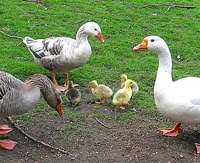 Within an hour I am rounding up a dog which has strayed from one of our neighbour's houses and is running amongst the geese and their newly hatched goslings. These six babies, now gawky on long legs, were, at Easter, still helpless balls of fluff, zealously guarded by their parents and a gaggle of aunties and uncles who were bold enough to fly at the sheep if they came too close. But even a bold goose is no match for a dog. By the time I have chased him home and returned to the house, it is getting on for midday.
 No matter, the weather is warm and sunny and the apple blossom hums with bees in the orchard. Perhaps an Easter lunch outside will make up for breakfast? We pile bread and salad onto plates and just as we head out of the kitchen the telephone rings: Is Michael there? There is water pouring through the ceiling of the Visitor Centre kitchen. It looks as if the tank has burst again...
 Next morning however, I find all in the top field still alive and well. In addition the noisy Canadas have hatched three young of their own on the Black Swan Pond. I count six ducklings, darting about, hunting flies on the water surface and also spot four moorhen chicks, hidden under the overhanging foliage that obscures their nest. The cuckoo has been calling for a week now.
 This surge of life brings its triumphs and tragedies. With the warm weather, two sheep, though treated already, succumb to fly-strike and Michael and his grandson, Mike, have the unenviable task of dealing with the flesh-eating maggots which have burrowed into their wool. And the heron returns to the Black Swan Pond and perches at the top of the weeping willow, waiting to swoop on my unsuspecting nursery.
 Two weeks on, I have four duckling survivors, but only one moorhen, lovingly tended, as only baby moorhens can be. The Canadas have taken their family to the safety of the Big Pond where they were welcomed by a raucous flotilla of geese. Meanwhile, despite their water drying up alarmingly fast, the top flock have continued to protect their goslings and their unflagging vigilance makes a very moving sight.
 And already it is May. Today's news becomes out of date even as I write it. Elder bushes flower where the apple and rowan bloomed before. Great drifts of red campion and blue alkanet lie between the trees along the Big Pond edge, the best I have ever seen and May blossom foams in the hedgerows. You would not guess that we have been without rain for five weeks or more. Shaun McCullagh came at Easter and did a new bird count for us, recording whitethroat and lesser whitethroat, blackcap and reed warbler this time, in addition to our usual residents. And Michael has met a baby fallow deer twice on his rounds in the early morning, which is lovely for the blog and (deer being voracious eaters of roses) rather worrying for the Herb Garden!
 Suddenly everything is bursting into life. While geese, ducks and moorhens are busy guarding their nests on the Reserve a tide of green is seeping over the hedgerows. Pussy willow is out. The chiffchaffs have arrived from Africa and you can hear their distinctive notes, calling their own names, quite clearly, among the other bird cries. And our family of farm animals is growing too. Two dear ginger-spotty piglets have joined the gang in the Smallholding and another lamb was born last week. On the Black Swan pond, the Canada Geese and the swans have called a truce and have settled down to nest beside one another on the island. While their womenfolk are occupied, the males warily patrol the waters round them, all raucous displays of greeting and warning temporarily halted. In the folk mythology of Finland, Tuonela, the Underworld, is surrounded by waters which are guarded by a lone black swan. Black swans come from Australia so the 'Swan of Tuonela' was a piece of pure imagination on the part of Finland's pre-christian storytellers, but their tale inspired a haunting tone poem by Sibelius, and I cannot help hearing his music in my head as I see our miniature epic unfolding here.
 Carpets of spring flowers are appearing now: primroses, violets, the beautiful oxlips, which have colonised a corner of the woodland coppice,
 and mantles of wild garlic, and bluebells are close behind, while the blackthorn, crab apples and orchard fruit trees are only days away from breaking bud.
 There are plans for some turkeys to join the hens in the orchard. Already the Oxford Sandy and Black piglets have turfed up the grass in their pen and learnt that a snout is a good powerful tool for levering fences up high enough to escape into the world at large. They can run fast too! Michael was called out two days ago to catch them before they set to helping to dig the vegetable beds!
 A week or so back we took delivery of two ponies, which Charlie Camp from Clayton made for us out of his locally grown chestnut wood, and they are now stationed close to the Indian Tepee and newly refurbished Wild West Fort in the Play Area, waiting for child adventurers to scramble on their backs. Charlie makes all manner of beautifully crafted items in wood, from wellie-racks to garden furniture and we are hoping to add his handiwork to the things for sale in our shop.

 Well, it's no use waiting for the weather this year. We are still sloshing about up to the ankles in mud beneath white, dreary skies, so the birds and animals on the Reserve are getting on with spring anyway. All the mallards on the black swan pond have dispersed to find their own breeding grounds, battle-scarred robins are a regular sight, as they scrap for a mate and the first frogspawn has appeared. We also have seven newborn lambs in the field. Everyone seems surprised that they should have come so early, but our sheep breed naturally, like wild animals and follow their own instincts without human intervention. And you can see their logic.
 This way the lambs have to be tough to survive the cold weather, but they can rely on their mothers' milk and body warmth for protection. They then benefit from the longest possible time to grow fat on grass before they have to face a winter alone. It is a joy to see them, black, cream and brown, chasing one another along the hedgerows at dusk, so sturdy and free.
 As for the rest of the reserve, the long walk beside the big pond is awash with snowdrops in full bloom, and spreading pools of primrose and purple crocus. The weeping willows are breaking bud and the deep green spikes of arum lily and wild garlic leaves are spearing the drab leaf-mould in the woods. If only the sun would put in an appearance, we would really believe the brown days of winter are behind us.
 Here we are rapidly running out of dry wood for the Rayburn. Michael seems to spend half the day sawing up old fence posts and dead branches and we have running battles over which items belong to the beetles and woodpeckers and which are fit to burn. Some sticky pine the other day gave us a chimney fire at supper time. An ominous crackling in the Rayburn flu alerted me and I called for assistance. Michael, a veteran fireman of 33 years service, looked at it quizzically and pronounced that it was only soot burning and would probably do the chimney good. "Shut everything down and see what happens", he said. My efforts to continue cooking were hampered by falling sparks and molten cinders and when the chimney plate began to glow I made a larger fuss: "You know, this really is on fire!" Michael considered the matter. Pottered outside to inspect the state of the chimney pot, rummaged briefly in his veterinary box and handed me a water pistol. "You could try squirting that up there if you like. There are no flames coming out of the top." The water pistol produced an angry sputtering and dribbles of tar, but gradually did the job. Apart from a few smuts in the risotto no real harm done. Of course we should get the chimney swept more often. 'Grandmother's Household Hints', an old American manual recommends dropping a live hen down once a year. The fluttering descent will dislodge soot most effectively! No mention of chicken's rights! More prosaically, Sussex lore advocates a holly branch. I might simply settle for calling in the sweep!
 One sad note. We lost dear old Charlie the donkey. Heaven knows how old he was,as he was already elderly when he came to us and that was over 16 years ago. This winter he became slower and slower at eating his food and Michael spent many long hours standing over him in the snowy weather, to fend off the cows who gobbled their rations so quickly and came foraging for more. We find ourselves still looking for his pale shadow and quiet welcome at the gate.